Christopher Nolan · Homer · Full Spoilers
The Odyssey Ending Explained: What Christopher Nolan Changed from Homer
The film reaches Ithaca—but it does not leave Odysseus, Penelope or Telemachus where Homer did. Here is what the new ending means and how it transforms the original epic.
Christopher Nolan’s The Odyssey follows the broad direction of Homer’s story: Odysseus survives the Trojan War, crosses a world of danger and returns to Ithaca. But the final destination is not the same as the ending.
For anyone searching for The Odyssey ending explained, the essential difference is this: Homer restores Odysseus to his household and kingdom, while Nolan sends him onward. In the film, Telemachus inherits Ithaca and Odysseus leaves with Penelope, sailing west after the violence that accompanies his return.
That change is not a minor adjustment made to shorten a long poem. It alters the meaning of the entire journey. Homer asks whether a displaced man can reclaim his place in the world. Nolan asks whether a man transformed by war can ever truly return to the person he was before it.
The Odyssey Movie Ending Explained
Odysseus finally returns to Ithaca after twenty years away: ten years fighting at Troy and another ten struggling to reach home. As in Homer, the kingdom he finds is not the one he left. Penelope is surrounded by suitors who consume the household’s wealth, while Telemachus has grown into adulthood beneath the threat of men who expect to inherit his father’s power.
The bow contest leads to the violent reckoning. Odysseus reveals himself and kills the suitors with the support of Telemachus and the loyal members of his household. Yet the victory does not restore the old order. Nolan presents the massacre as the final consequence of a cycle that began at Troy rather than a clean act of heroic justice.
Why does Telemachus become king?
In the film, Telemachus assumes responsibility for Ithaca. The decision signals that the kingdom cannot simply return to the moment before Odysseus departed. His son is no longer the infant he left behind, and Ithaca cannot remain suspended indefinitely in expectation of its absent ruler.
Telemachus’ succession also completes his coming-of-age story. He begins as a young man living beneath his father’s legend and ends by inheriting the difficult work of leadership. Odysseus wins back the possibility of a future, but that future belongs to his son.
Why do Odysseus and Penelope sail away?
Odysseus and Penelope leave Ithaca together. Their voyage can be understood as exile, release and acknowledgement. Odysseus cannot pretend that the years of violence have left him unchanged. Penelope, meanwhile, chooses to go with him rather than remain as a symbol frozen in faithful waiting.
The westward journey also fulfills an emotional idea established earlier in the film: sailing toward the horizon rather than accepting the path imposed by war and kingship. Their marriage survives, but the life they recover is not the life they lost.
How Does Homer’s Odyssey Actually End?
Homer’s ending continues well beyond the slaughter of the suitors. Penelope does not immediately accept the returning stranger as her husband. She tests him with a private detail about their marriage bed, which Odysseus built around a living olive tree. His reaction proves that he possesses knowledge no impostor could have.
The bed is one of the epic’s most powerful symbols. It is rooted, living and impossible to move without destroying it. After years of wandering, Odysseus is recognised through something he made permanent. Penelope’s test also shows that she matches his intelligence; their reunion depends on shared cunning, not appearance alone.
Homer then sends Odysseus to meet his elderly father, Laertes. Even here, Odysseus initially conceals his identity before finally proving who he is. Meanwhile, the families of the slain suitors prepare revenge. A new battle threatens to begin until Athena intervenes under the authority of Zeus and imposes peace.
The final word of Homer’s narrative is therefore not exile but reconciliation. Odysseus remains connected to Ithaca, his household and the restored social order. The cycle of retaliation is stopped by divine command.
What Happens to Odysseus, Penelope and Telemachus?
The changed conclusion becomes clearest when we look at the three members of the Ithacan family separately. All have spent twenty years living inside the consequences of the same departure, but each has experienced a different Odyssey.
Odysseus: from returning king to wandering survivor
Odysseus begins the story defined by movement and desire. Everything he does is directed toward reaching Ithaca, yet his identity is repeatedly stripped away. He loses his fleet, companions, status and even his name during the Cyclops episode. When he finally arrives, he is hidden beneath the appearance of a beggar.
Homer resolves that instability by restoring recognition. Argos, Eurycleia, Telemachus, Penelope and Laertes each recognise Odysseus through a different sign. Together, those scenes rebuild the person who disappeared into war. Nolan offers a less complete restoration. Odysseus is recognised, but recognition does not cure him. His departure suggests that surviving the journey and resuming the throne are not the same achievement.
Penelope: from faithful queen to partner in departure
Penelope’s Odyssey occurs almost entirely within the palace. She preserves the household by delaying the suitors, promising to choose a husband only after she finishes weaving a burial shroud and secretly undoing the work each night. Her intelligence is defensive but active: she controls time when she cannot control the men occupying her home.
In Homer, the marriage-bed test provides the climax of that intelligence. Penelope refuses to surrender judgment merely because the stranger claims her husband’s name. In the film, the altered recognition weakens that specific act of cunning, but the final voyage gives her a different agency. Rather than remain behind while men decide Ithaca’s future, she chooses to leave alongside Odysseus.
Telemachus: from the son who waits to the king who remains
Telemachus begins both versions without adult authority. The suitors treat him as an obstacle rather than a ruler, and his father’s fame makes it difficult to form an identity of his own. His early travels to Pylos and Sparta are therefore more than a search for information. They introduce him to the world of the generation that fought at Troy.
Homer allows father and son to act together, restoring the household through cooperation. Nolan goes further by giving Telemachus the kingdom. Odysseus’ greatest legacy is no longer the continuation of his own reign, but the possibility that his son can lead differently.
Penelope and Odysseus: is their departure a happy ending?
The answer depends on what happiness means after the story’s violence. They are reunited and choose one another, which gives the ending emotional hope. But they do not recover the years taken by war, and the voyage is not presented as a return to innocence.
It is better understood as a bittersweet ending. Their marriage survives, Ithaca passes to Telemachus and the couple gains a future beyond the roles of waiting queen and conquering king. At the same time, leaving home acknowledges that victory has costs that cannot be erased by a final embrace.
The Odyssey Movie vs Book: How the Endings Compare
| Story element | Homer’s Odyssey | Nolan’s film |
|---|---|---|
| Odysseus’ future | His household and authority are restored in Ithaca. | He leaves Ithaca after Telemachus succeeds him. |
| Penelope’s recognition | She tests him through the secret of their rooted marriage bed. | The recognition is reshaped and the bed test is omitted. |
| Telemachus | He fights beside his father and remains heir to the household. | He becomes the ruler of Ithaca. |
| The suitors’ families | They seek revenge until Athena imposes peace. | The film moves toward departure rather than divine reconciliation. |
| Final meaning | Home, continuity and social order are restored. | Homecoming gives way to guilt, historical change and another voyage. |
Eight Major Changes Christopher Nolan Made to Homer
Nolan’s different ending is part of a much wider adaptation strategy. Contemporary reporting has described the film as preserving the epic’s central journey while reorganising, omitting and reinventing major episodes. The following changes most strongly affect how viewers understand the conclusion.
Odysseus does not settle back into kingship
Homer restores him to Ithaca. Nolan makes permanent restoration impossible and transfers political responsibility to Telemachus.
Penelope’s marriage-bed test is removed
Homer’s Penelope verifies Odysseus through the secret of the olive-tree bed. The film chooses a different recognition device, reducing one of the poem’s clearest demonstrations of Penelope’s strategic intelligence.
The reunion with Telemachus becomes action
In the poem, father and son recognise one another privately in the hut of Eumaeus and plan their response. Nolan turns the meeting into a more physical rescue and accelerates the recognition.
The Trojan War casts a longer shadow
Homer begins after Troy and reveals the war through memories and stories. The film gives the destruction of Troy greater dramatic weight, making Odysseus’ guilt central to his later choices.
The gods become more distant
Divine debate drives Homer’s plot, with Athena repeatedly assisting Odysseus. Nolan retains Athena but makes the divine world less visible and less capable of neatly restoring order.
The Cyclops episode becomes less about wordplay
Homer’s encounter depends on the famous “Nobody” deception and Odysseus’ disastrous decision to reveal his name. The film foregrounds physical danger and trauma, changing the balance between cunning and violence.
Circe and Calypso are radically reframed
Homer gives both episodes extended duration and complex divine intervention. Nolan compresses them and uses transformation, memory and psychological control to keep the focus on Odysseus’ damaged identity.
The final peace is replaced by departure
Homer closes the threat of renewed bloodshed through Athena. Nolan avoids that divinely guaranteed settlement and ends with uncertainty beyond Ithaca.
For a detailed journalistic comparison of the adaptation, see the Los Angeles Times analysis of Nolan’s changes to Homer. Our focus here is how those decisions alter the journey’s final meaning.
What Does the Final Voyage Mean?
The westward voyage refuses the comfort of a conventional homecoming. Odysseus has reached the place he spent years seeking, yet arrival does not erase experience. The warrior, husband and king who returns is not identical to the man who sailed for Troy.
Home is no longer a place that can remain unchanged
Homer understands home as something threatened but recoverable. Nolan treats it as something history transforms. Ithaca exists, Penelope remains and Telemachus survives, but twenty years cannot be reversed. The decision to leave acknowledges that homecoming may mean accepting change rather than restoring the past.
The hero gives up the centre of the story
Odysseus’ departure allows Telemachus to become more than the son who waits. The legendary hero moves beyond the political centre, making space for a generation that did not choose the Trojan War but must live with its consequences.
Penelope becomes a traveller
In most of the story, Penelope’s power comes from endurance within Ithaca. Nolan’s final choice turns her into a participant in the voyage. She does not merely receive Odysseus back; she helps decide what their shared future will be.
Why Does the Film Connect the Ending to the Bronze Age Collapse?
The story is set in the legendary aftermath of the Trojan War, traditionally placed near the end of the Late Bronze Age. Around the eastern Mediterranean, palace systems declined, settlements were destroyed or abandoned and long-distance networks changed dramatically. The causes remain debated and likely involved multiple pressures rather than a single catastrophe.
Nolan uses this historical horizon to enlarge Odysseus’ personal guilt. The hero imagines a world in which the civilisation he knows will disappear and later generations will inherit only fragments and songs. The device connects individual memory with cultural memory: what happens when survivors can tell their stories but the society that understood them no longer exists?
Homer’s poems themselves emerged through a long oral tradition and reached written form centuries after the period they describe. That distance is part of their power. The epics preserve memories of palaces, warriors, gifts and voyages while reshaping them for later audiences.

Does Nolan’s Ending Betray Homer?
Viewers can reasonably prefer Homer’s conclusion. Removing the marriage-bed test changes Penelope’s role, while replacing reconciliation with departure changes the epic’s political and moral structure. The poem’s ending insists that violence must stop if society is to survive; the film is more sceptical about whether violence can be resolved so completely.
But adaptation is not transcription. A feature film must choose a centre from a poem containing twenty-four books, multiple narrators, embedded stories and divine councils. Nolan’s version uses Homer as the foundation for a modern meditation on war, guilt and historical repetition.
The most useful question may not be whether the film is perfectly faithful. It is what becomes visible through the difference. Comparing the two endings sends audiences back to Homer, where they discover that the familiar story is stranger, more intelligent and more morally complicated than a simple monster-filled adventure.
What Happens After Homer’s Odyssey?
Homer closes with peace imposed in Ithaca, but later ancient traditions imagined further journeys. The prophet Tiresias tells Odysseus that he must travel inland carrying an oar until he reaches people who do not recognise it, then make an offering to Poseidon. The poem predicts that death will eventually come to him gently, away from the violence of the sea.
Later writers developed alternative endings and descendants, but these belong to traditions beyond Homer’s surviving poem. Nolan’s westward voyage is therefore not a direct filming of a single canonical sequel. It is a new conclusion built from the epic’s themes of wandering, consequence and the impossibility of complete return.
Where Can You Follow the Story in Greece?
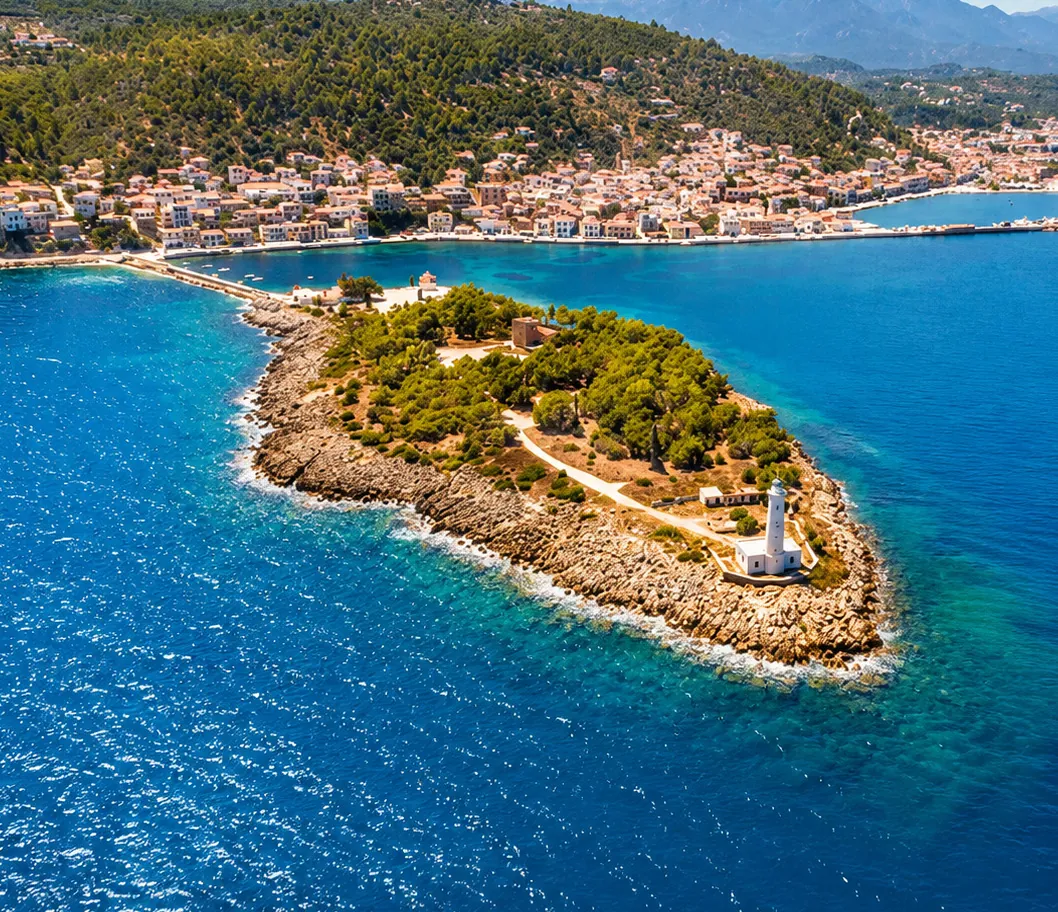
The ending brings the story back to Ithaca, the real Greek island associated with Odysseus. Yet the wider Homeric world extends across Greece—from Mycenae and Sparta to Pylos and the Ionian Islands.
Travellers can explore the real places behind Homer’s Odyssey, visit the kingdoms connected with Agamemnon, Menelaus and Nestor, and discover how archaeology complicates the boundary between myth and history. Film enthusiasts can also follow The Odyssey filming locations in Greece, including Methoni, Acrocorinth and the landscapes of Messenia.
This is where a search that begins with an ending becomes a new journey. The movie changes Homer, but both versions point toward landscapes that still exist and stories embedded in modern Greece.
Go beyond the ending
Follow the Real Journey Across Greece
Following Odysseus brings together the Homeric kingdoms, archaeological sites, ancient myths, filming locations and five complete itineraries behind the epic.
Discover the GuideThe Odyssey Ending Explained: Frequently Asked Questions
How does Christopher Nolan’s The Odyssey end?
After the suitors are defeated, Telemachus assumes responsibility for Ithaca while Odysseus and Penelope leave together on a new voyage west.
Is the movie ending the same as Homer’s Odyssey?
No. Homer restores Odysseus to his household and ends with Athena imposing peace. The film replaces that restoration with departure and uncertainty.
Does Odysseus become king of Ithaca again?
In Homer, his authority is restored. Nolan’s film instead allows Telemachus to succeed him as Odysseus leaves Ithaca.
How does Penelope know Odysseus in the original poem?
She tests him by ordering their marriage bed moved. Odysseus knows it cannot be moved because he built it around a living olive tree, proving his identity.
Why did Nolan change the ending?
The altered ending supports the film’s emphasis on war, guilt, memory, generational change and the difficulty of returning to an unchanged life.
What happens to Telemachus at the end?
The film positions Telemachus as Ithaca’s new ruler, completing his transition from a son living beneath a legend to an independent leader.
Does The Odyssey end after the suitors are killed?
No. Homer continues with Penelope’s recognition, Odysseus’ reunion with Laertes and a final conflict stopped by Athena.
Is Ithaca a real place?
Yes. Ithaca is a real Ionian island in Greece and has been associated with Odysseus since antiquity, although the exact location of a historical Homeric palace remains debated.
The Ending Is Another Beginning
Nolan’s final image changes the answer to the question that drives the epic. Odysseus reaches home, but reaching home is not the same as returning to the past. Ithaca survives through Telemachus, while Odysseus and Penelope carry their history toward another horizon.
Homer offers restoration secured by recognition, rooted marriage and divine peace. Nolan offers movement, uncertainty and the possibility that some journeys continue because their travellers cannot become who they once were.
Both endings return us to the same enduring idea: an Odyssey is measured not only by the distance travelled, but by what remains of a person when the journey is over.
Editorial sources: This comparison draws on Homer’s Odyssey and recent reporting and analysis from the Los Angeles Times, The Guardian, ELLE and TheWrap. The article uses original Greek destination photography; no Universal Pictures stills have been reproduced.